RESOURCE ACCESS IS A SYSTEMS ISSUE
Building the infrastructure behind clearer pathways to support.
Oklahoma Resource Access Network strengthens the information, relationships, and practical learning pathways that help people and community partners find, understand, and connect to support with greater clarity, coordination, and care.
SEE THE WORK UNDERWAY
EXPLORE THE INVESTMENT CASE

VERIFIED INFORMATION
TRUST-CENTERED COLLABORATION
APPLIED LEARNING PATHWAYS
RESPONSIBLE PUBLIC ACCESS
WHY THIS WORK EXISTS
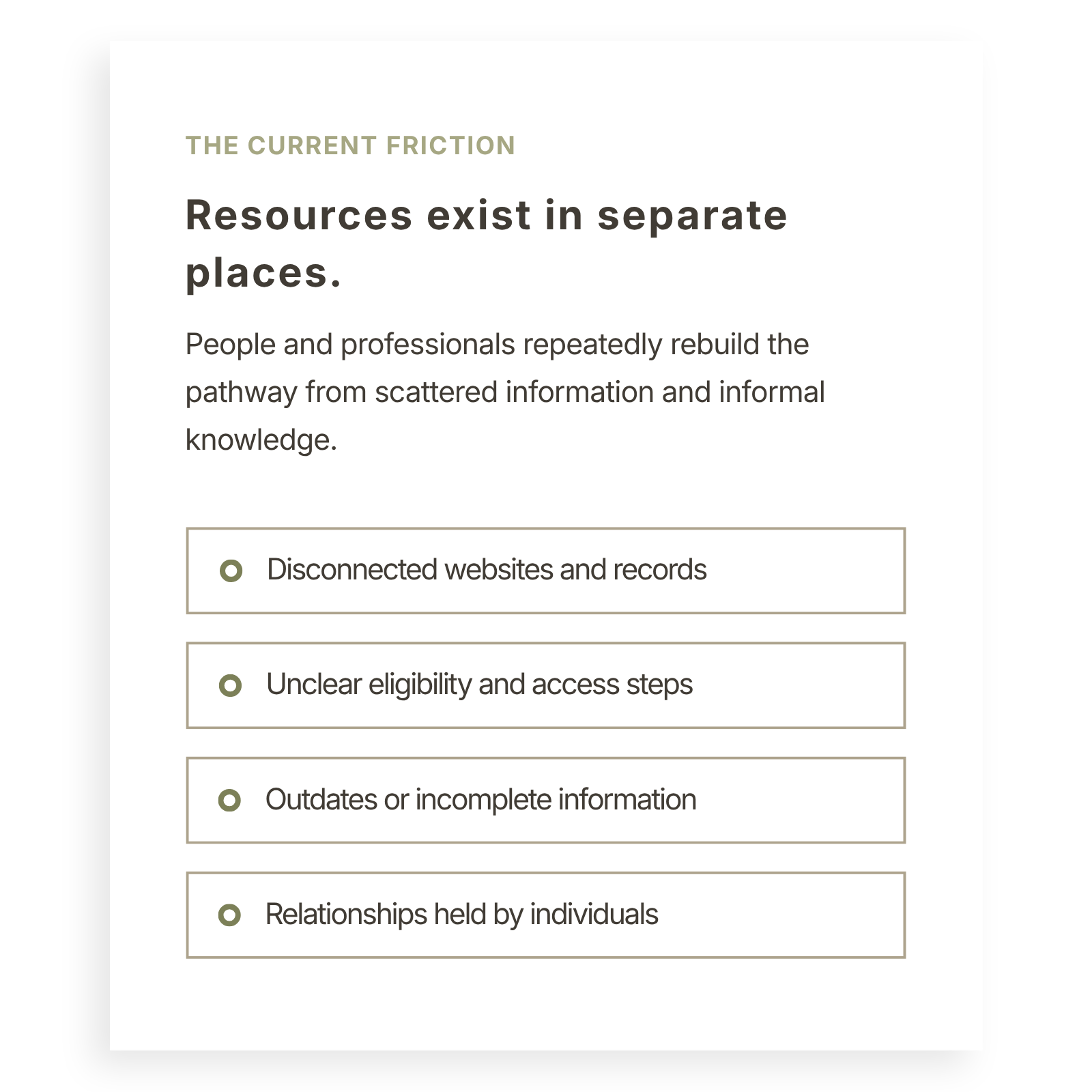
The gap is not always the resource. Sometimes it’s the pathways.
Oklahoma has organizations, programs, professionals, volunteers, and community knowledge working across the state. But information may be scattered or outdated. Access procedures may be unclear. Referral knowledge may depend on personal relationships. Program changes may not reach external systems. Community members and frontline professionals may have to rebuild the pathway every time a need occurs.
It’s more than an information problem. Access also depends on accurate information, direct connection, shared knowledge, strong relationships, and systems that reduce unnecessary confusion and delay.
ONE MISSION, THREE CONNECTED PRIORITIES
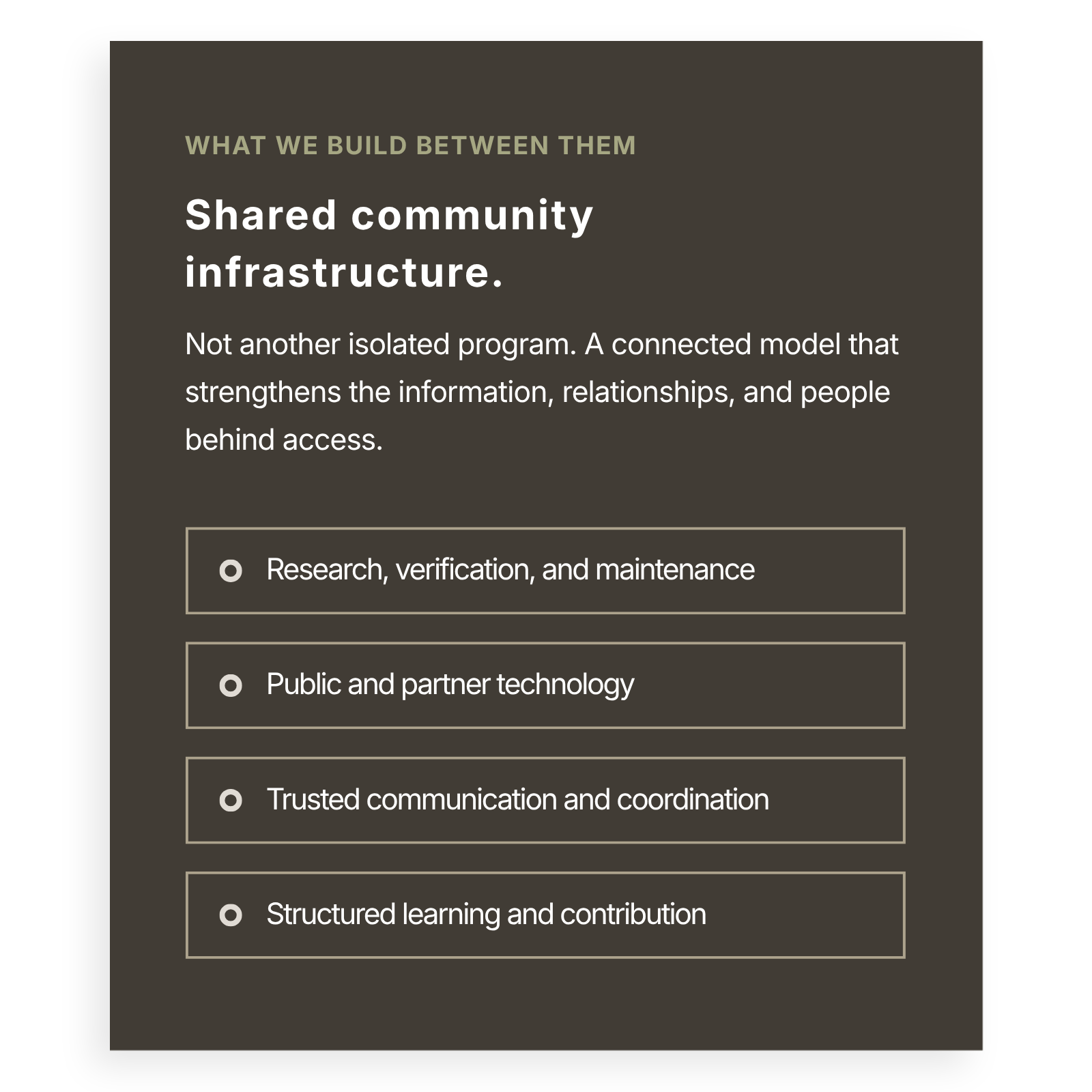
A systems model, not a collection of unrelated programs.
01
Community Resource Infrastructure
Strengthening the shared information and platform infrastructure behind resource access, from research and human validation through responsible public use.
RESOURCE MAPPING + VERIFICATION
OKLAHOMA RESOURCE HUB
WORK UNDERWAY
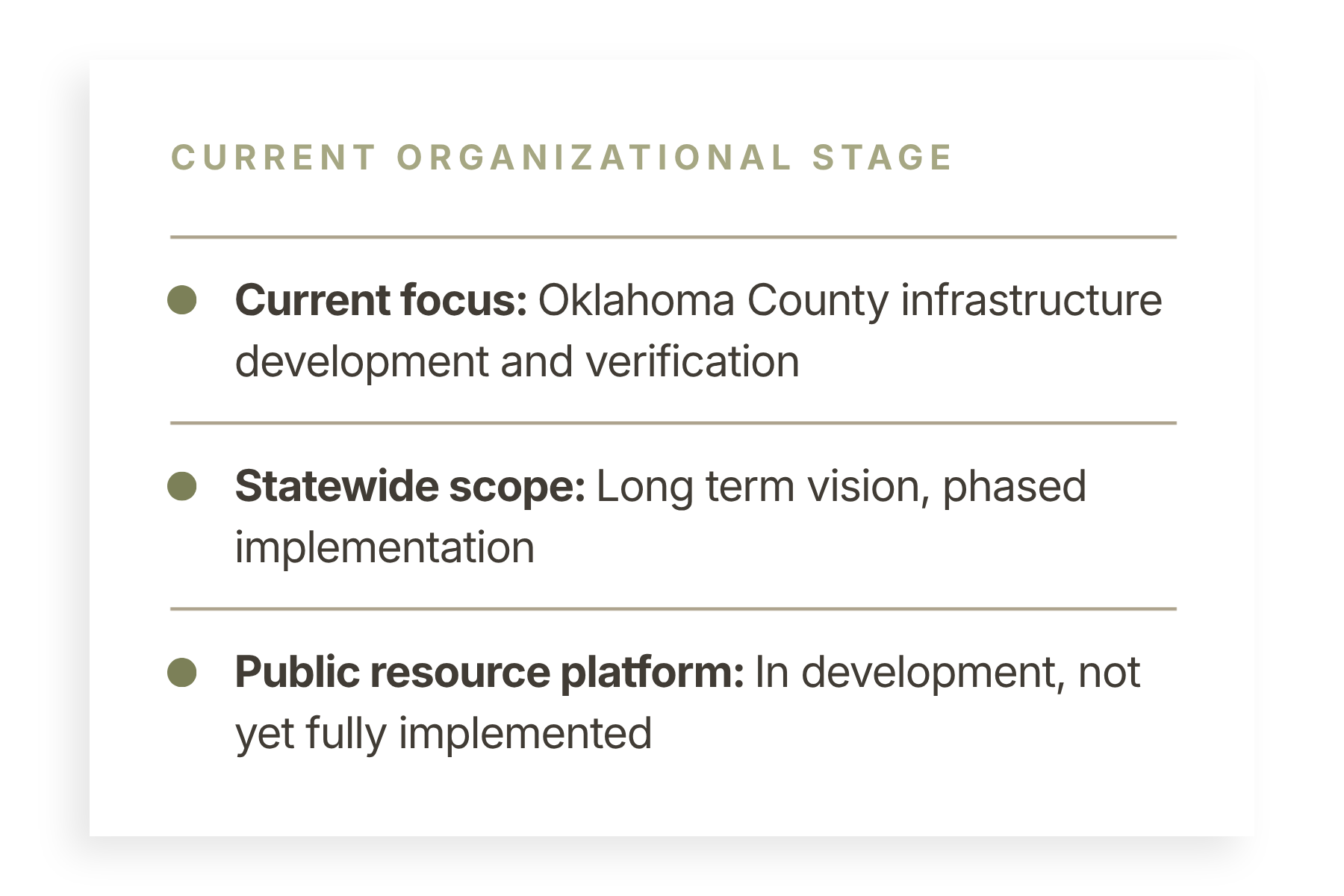
Oklahoma County verification systems
Data quality and outreach workflows
Platform configuration and readiness
Responsible phased implementation
02
03
Community Collaboration Infrastructure
Strengthening the relationships, communication, and coordination that help resource access work more effectively in practice.
OKLAHOMA RESOURCE COLLABORATIVE
PRIVATE PARTNER PLATFORM
WORK UNDERWAY
Weekly virtual partner meetings
Monthly in-person connection
Cross-sector information exchange
Private participant platform development
Applied Community Systems Pathways
Creating structured ways for students, workforce participants, volunteers, and community members to build skills while contributing to public-benefit systems work.
INTERNSHIPS + PRACTICUMS
WORKFORCE PLACEMENTS
VOLUNTEER LEARNING PROJECTS
WORK UNDERWAY
Role and workflow development
Workforce partnership planning
Supervised verification support
Learning-centered contribution models
WORK UNDERWAY
The scale is significant.
So is the responsibility to get it right.
We are building the infrastructure that makes access clearer, coordination stronger, and community resources easier to find and use. These numbers show the scope of the work ahead and the steady progress we are making today.
20,000+
Potential resource entities identified statewide
An initial research pool for future review and verification. This is not a count of verified or published resources.
STATEWIDE IDENTIFICATION · AS OF AUGUST 2026
~8800
Potential Oklahoma County entities identified
The current OK county research pool before direct verification, outreach validation, and quality review.
OK COUNTY IDENTIFICATION · AS OF AUGUST 2026
~195
Connected Community Collaborative partners
Participation has grown from an initial group of six, with recurring virtual and in-person opportunities for connection and information exchange.
PARTICIPATION SNAPSHOT · AS OF AUGUST 2026
40%
Oklahoma County verification pilot goal
A defined county-level goal supported by current verification, automation, outreach, quality review, and capacity-building work.
2026 OKLAHOMA COUNTY PILOT GOAL
STATEWIDE VISION. PHASED IMPLEMENTATION.
We are building for statewide access without rushing the work required to get there.
Verification quality is the foundation of responsible public access.
Build the organizational capacity required for responsible implementation
Strengthen leadership, program management, outreach and communications, financial systems, governance, supervision, and documented operating processes.
NOW
Advance Oklahoma County verification and platform readiness
Continue research, direct validation, quality assurance, technology configuration, user guidance, controlled testing, and re-verification planning.
BUILD
Measure what is working and strengthen what needs improvement
Track response rates, record complexity, partner participation, data quality, referral knowledge, user feedback, workflow performance, and implementation barriers.
LEARN
Grow only when infrastructure and evidence support it
Use lessons from Oklahoma County to guide future county sequencing, staffing, partnerships, technology needs, and responsible public implementation.
EXPAND

WHY INFRASTRUCTURE IS HUMAN WORK
Every failed pathway costs more than time.
When resource information is outdated, incomplete, or hard to find, the burden shifts to people already managing real pressures and to the frontline professionals working to connect them with support.
People are often doing everything they can.
The challenge is that the pathways around them may be fragmented, outdated, or difficult to navigate
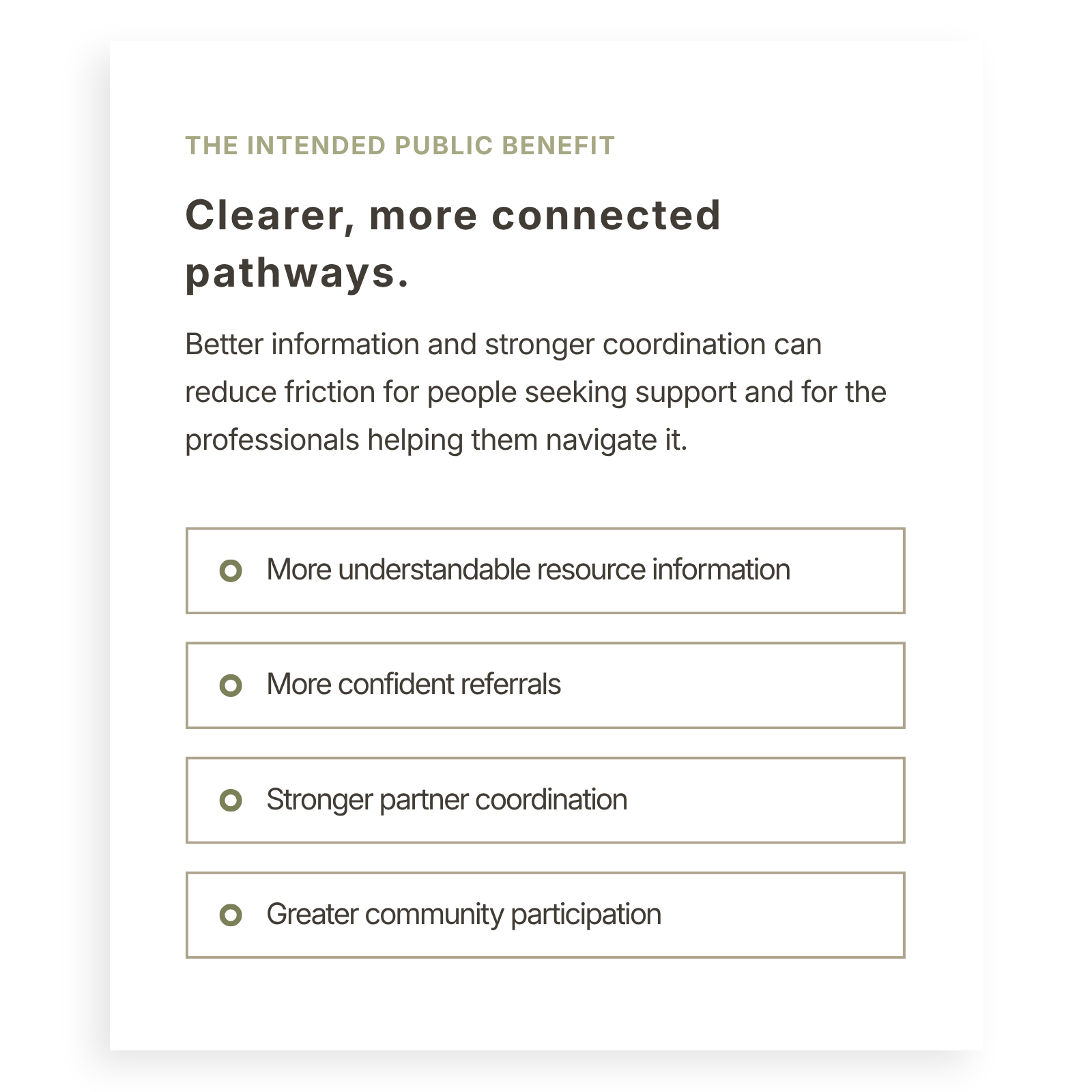
This work is about reducing the friction with clearer information, stronger relationships, and more responsible systems.
THE INVESTMENT CASE
Invest in the infrastructure behind access.
Oklahoma Resource Access Network strengthens the information, relationships, and practical learning pathways that help people and community partners find, understand, and connect to support with greater clarity, coordination, and care.
SEE THE WORK UNDERWAY
EXPLORE THE INVESTMENT CASE
Leadership and operating capacity
Executive leadership, program management, administration, financial systems, compliance, governance support, and institutional continuity.
Technology and public readiness
Platform development, accessibility, testing, privacy, user guidance, feedback systems, and responsible implementation.
Applied learning pathways and supervision
Structured roles, onboarding, training, supervision, feedback, and meaningful skill-building through mission-aligned work.
Verification and data stewardship
Research, direct outreach, validation, quality review, documentation, maintenance, and re-verification systems.
Partner engagement and communications
Collaborative coordination, outreach, public education, partner communication, participant support, and community engagement.
Evaluation and systems learning
Clear measures, implementation milestones, workflow learning, community feedback, and evidence to guide future improvement and expansion.